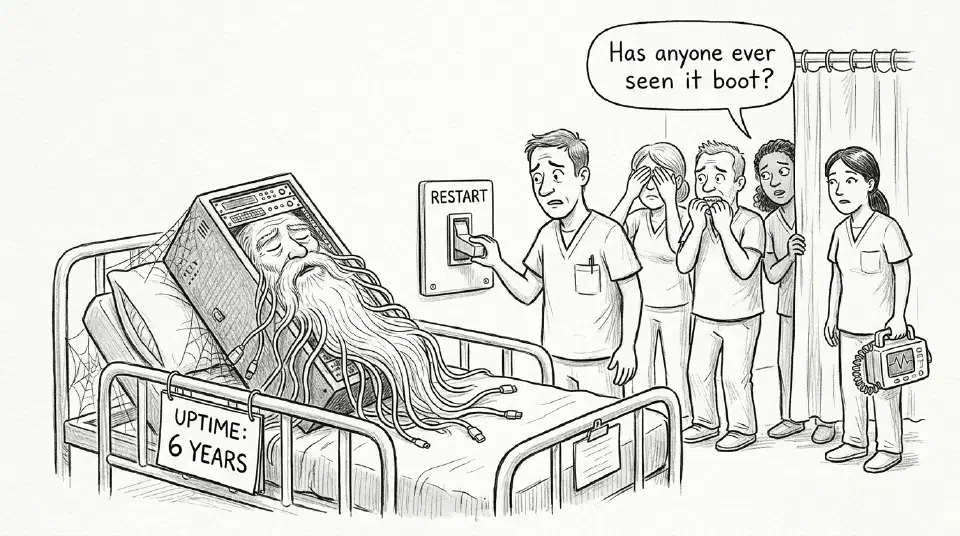
On November 17, part of the National Security Agency’s classified network stopped working after routine patches. Director of National Intelligence Jay Clayton said the patching for vulnerabilities in PHP, a programming language behind much of the web, “has caused some of these systems to not come back up when you patch them as expected”. Part 1 counted the flood of fixes behind such patches. This part covers the step that failed.
A restart looks like the safe part of an update, because a laptop does one every few weeks and comes back. A server is a different case. Installing an update replaces files on disk, but programs that are already running keep using the old code they loaded into memory, so the fix only takes effect when they restart. Servers often go months or years between restarts, and in that time people change things by hand that nobody tests until the next startup. This post calls that growing risk reboot debt: every month without a restart makes the next one more likely to fail. Later sections measure both halves on test systems.
Why companies patch, and why 2026 raised the stakes
The first reason is attackers. A patch closes a vulnerability, and every vulnerability gets a public ID called a CVE (Common Vulnerabilities and Exposures). The US Cybersecurity and Infrastructure Security Agency (CISA) keeps a list of the CVEs that attackers are known to use, the Known Exploited Vulnerabilities catalog (KEV). Part 1 measured how fast that list grows: 321 additions by late November 2026, against 224 in the same period of 2025.
The second reason is rules. Each one sets its own clock, but each binds a narrower group than its name suggests:
| Rule | Who it binds | The clock |
|---|---|---|
| CISA Binding Operational Directive (BOD) 26-04, since June 10, 2026 | US federal civilian agencies | 3 days for an internet-exposed vulnerability that an attacker can automate and that gives total control |
| Federal Risk and Authorization Management Program (FedRAMP) rules, required from December 7, 2026 | Cloud providers that sell to US federal agencies | As short as 4 days, 12 hours in the strictest class. The previous windows were 30, 90 and 180 days by severity. |
| Payment Card Industry Data Security Standard (PCI DSS) v4.0.1, requirement 6.3.3 | Any company that handles payment cards | One month from release, for patches to critical vulnerabilities |
| EU Cyber Resilience Act, Article 14, since September 11, 2026 | Makers of software and hardware sold in the EU | Report an actively exploited vulnerability within 24 hours, a full notification within 72 |
| System and Organization Controls 2 (SOC 2) audit | Nobody. Companies choose the audit, usually because customers ask for the report. | None. The company writes its own patch window, however long, and the auditor checks that it was followed. |
Apart from card payments, most companies, private or publicly traded, are bound by none of these directly. They still feel them second-hand: many use CISA’s KEV list as their own priority queue, and the third reason passes the rest along. It reaches companies that none of these rules name. A software-as-a-service (SaaS) company never ships software to anyone, so it can look exempt. Its customers are not. A bank under PCI or an agency under FedRAMP passes its own deadlines down to its vendors through contracts and security questionnaires, and after every large disclosure customers ask whether the vendor is affected and when it will be fixed.
The fourth reason is the vendor’s calendar: software past its end of support gets no more fixes, a case the last section covers.
2026 tightened every one of these at once. Part 1 counted more than twice as many published CVEs as in 2025, CISA’s shortest deadline fell to three days, FedRAMP pulled its new rules forward by six months to match, and the Cyber Resilience Act’s reporting clock started in September.
What gets patched, and how far behind fleets run
A single server carries several layers of software, and each layer gets fixes from a different source on a different schedule. From the bottom up:
- Firmware and processor microcode: the code built into the hardware itself. Intel ships microcode fixes in numbered platform updates, which reach a server only after the server maker packages them.
- The kernel: the core of the operating system, which controls memory, disks and network.
- Operating system packages: the libraries and tools the distribution ships, including glibc (the standard C library that nearly every program on Linux loads) and OpenSSL (the encryption library).
- The database engine: PostgreSQL, MySQL, Kafka, Redis, Elasticsearch.
- Language runtimes and application libraries: Java, Python and Node.js, and the packages applications pull in from public repositories.
In the cloud, the bottom of that stack moves to the provider. Firmware, microcode and the physical hosts are always the cloud provider’s job. The kernel and operating system packages are the provider’s job only on managed services such as Amazon Web Services (AWS) Lambda, Fargate or Relational Database Service (RDS). On a plain rented virtual machine, such as an AWS Elastic Compute Cloud (EC2) instance, the customer still patches its own kernel and packages. The section on the cloud below shows where each service draws that line.
The following table shows how often each layer ships fixes in principle, and when a fix actually takes effect:
| Layer | Who ships fixes | Schedule | Shipped in 2026 | Takes effect after |
|---|---|---|---|---|
| Linux kernel | kernel.org, then the distribution | Stable updates “usually once a week” | 56 releases of the 6.12 long-term kernel | A reboot |
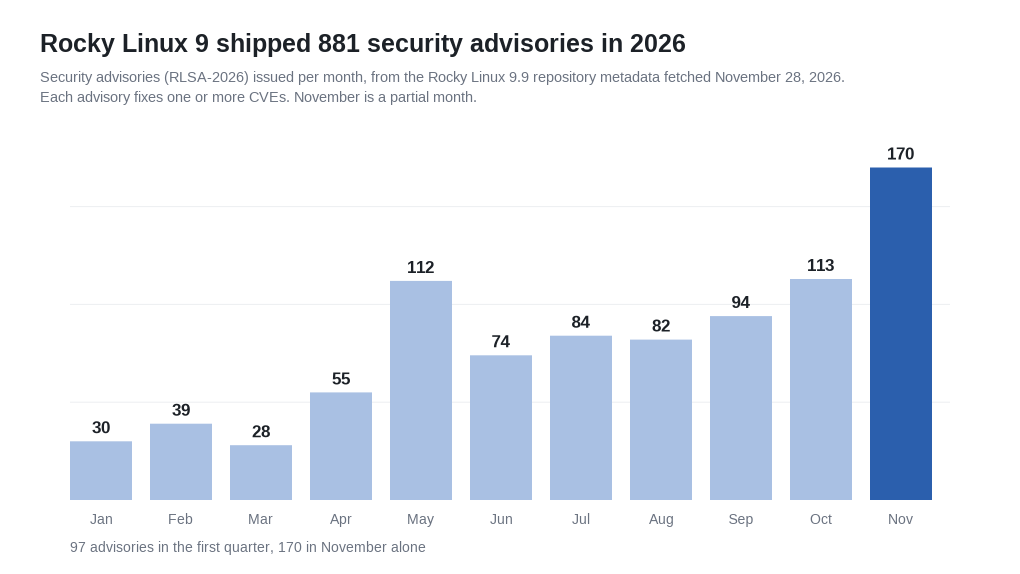
| Operating system packages | The distribution (here, Rocky Linux 9) | As each fix is ready | 881 security advisories | Every program that loaded the old library restarts |
| Processor microcode | Intel, through the server maker | Platform updates on February 10, May 12 and August 11 | At least 3 (February to August) | A reboot, or a firmware update |
| PostgreSQL | The PostgreSQL project | Second Thursday of February, May, August and November, as a minimum | 4 scheduled releases plus 1 out of cycle | A database restart |
| MySQL and Java | Oracle | Quarterly Critical Patch Updates, plus monthly security updates since May 28, 2026 | A scheduled release every month, plus 5 emergency alerts | A restart of the database or application |
| Windows | Microsoft | Second Tuesday of each month | 11 so far | Usually a reboot |
| Node.js | The Node.js project | When needed, announced in advance | Irregular | An application restart |
| Application libraries | Each open-source project | Whenever the maintainers release | No single count | A rebuild and redeploy of the application |
The Rocky Linux count comes from the advisory metadata in the Rocky Linux 9.9 repository, fetched on November 28:
Add up one ordinary server, say Rocky Linux on Intel hardware running PostgreSQL and a Java application, and the schedule in theory is a kernel fix about every week, a few operating system advisories every day, a database release every quarter and an Oracle release every month. A patch is itself a change, and since 2024 alone, updates from major vendors have broken the systems they were meant to fix:
| When | Layer | Update | What broke |
|---|---|---|---|
| Jul 2024 | Database | MySQL 8.0.38, 8.4.1 and 9.0.0 | A server with 8,001 or more tables could not be restarted. Percona warned users not to upgrade. |
| Jul 2024 | Security agent | CrowdStrike Falcon content update (configuration data, not code) | About 8.5 million Windows machines crashed |
| Nov 2024 | Database | PostgreSQL 17.1 and the other minor releases | Broke compiled extensions such as TimescaleDB. Out-of-cycle release a week later. |
| Feb 2026 | Database | PostgreSQL 18.2 and the other minor releases | The CVE-2026-2006 fix broke substring() on non-Latin text and could halt replicas. Out-of-cycle release two weeks later. |
| Apr 2026 | Windows Server | KB5082142 | Domain controllers using Privileged Access Management restarted repeatedly. Out-of-band fix five days later. |
Every one of these came from a vendor with its own release testing, and every one reached customers’ production systems before anyone caught it.
In practice, fleets run far behind. The published measurements come from breach investigators, scanning vendors and package registries, each counting something different:
| Source | What it measured | Result |
|---|---|---|
| Verizon Data Breach Investigations Report 2025 | Vulnerabilities on the KEV list, in organizations’ scans | 38% fully fixed during the year, median 38 days |
| Same report | Exploited flaws in internet-facing devices and virtual private networks (VPNs) | 54% fully fixed, median 32 days |
| Verizon Data Breach Investigations Report 2026 | KEV vulnerabilities in 2025, more than 13,000 organizations | 26% fully fixed, median 43 days |
| Edgescan Vulnerability Statistics Report 2026 | Vulnerabilities found in 12 months at companies with 1,000+ employees | 37% still open at the end |
| Cyentia Institute, Patching, Fast and Slow (2023) | Time until half of known vulnerabilities are closed | 36 days on Microsoft systems, 369 days on network appliances |
| Sonatype, December 2025 | Log4j downloads in 2025, four years after the Log4Shell fix | About 13%, roughly 40 million downloads, still vulnerable |
| Qualys, July 2024 | OpenSSH servers on the internet when the regreSSHion flaw was disclosed | Over 14 million potentially vulnerable |
The vendor reports count their own customers, and the two Verizon reports measure differently, so the rows do not combine into one trend. They agree on the gap. CISA’s shortest deadline is three days, and the typical exploited vulnerability takes more than a month to close when it gets closed at all.
The best-documented case of that gap is Equifax. According to the US Government Accountability Office’s report on the 2017 breach, the US Computer Emergency Readiness Team (US-CERT) published the Apache Struts vulnerability on March 8, 2017, and attackers were scanning Equifax for it two days later. Equifax did install the patch “throughout the company”, but the vulnerable software “was not properly identified as being present on the online dispute portal”. Attackers began taking data through that portal on May 13, and it took 76 days to notice.
What one update changes, and why databases suffer most
To see what a routine update does, I ran dnf update (the Rocky Linux package update command) on two official Rocky Linux 9 container images on November 28: one built on November 12 and one built on May 25. Both start with about 150 packages, which is far fewer than a real server carries, so the counts are a floor:
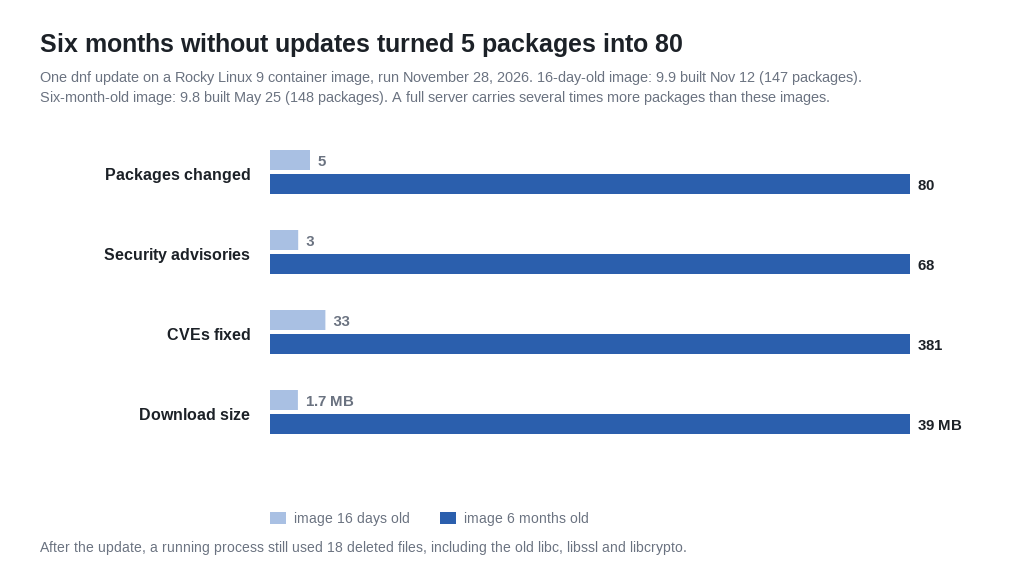
The 16-day-old image needed 5 packages. The six-month-old image needed 80, fixing 381 CVEs across 68 advisories, one of them rated critical. The size of a single fix says little about its reach, though. Updating for one glibc CVE alone would have changed 3 packages and downloaded 2 MB. After the full update, dnf needs-restarting -r named glibc as the reason “Reboot is required to fully utilize these updates”, because nearly every program on the system has glibc loaded. A Python process that was already running when the update started was still using 18 deleted files, the old glibc, libssl and libcrypto among them. Until something restarts, the system reports the new version and runs the old one.
The second test went after reboot debt directly. On a Rocky Linux 9.9 system (an OrbStack Linux machine, a lightweight system container that boots its own systemd), I made the kinds of changes that pile up on long-running servers, then restarted it:
| Change made while running | After the restart |
|---|---|
Disk mounted by hand, not added to /etc/fstab | Gone |
| Network route added by hand | Gone |
| Program started from a terminal | Gone |
| Service started but never enabled to start at boot | Not running |
| One-line typo in the configuration of the SSH (Secure Shell) server, the remote login service | SSH failed to start: “Failed to start OpenSSH server daemon” |
The last row is the dangerous one. The typo cost nothing for as long as the server stayed up, because the running SSH server had read its configuration before the typo existed. At the restart, the server lost the one way to log in and fix it remotely.
(OrbStack machines share their host’s kernel, so kernel settings changed with sysctl were out of scope here; a real reboot loses those too.)
sysctl vanishes at that restart unless someone wrote it back. The patch restart then surfaces a change made months earlier, and the team debugs the patch.Databases add two problems on top of this. The first is the restart itself. A database writes every changed page from memory to disk before it stops cleanly, and after a crash or a hard stop it replays its transaction log on the way back up. Both grow with memory and log size: a MySQL server with a 64 GB redo log can take 5 to 10 minutes to come back, even on fast hardware, and then its cache has to refill before queries run at full speed. Every open connection drops along the way, and an application without retry logic sees a minor database patch as an outage.
Production databases avoid most of that downtime by running as clusters of three or more nodes, a primary that takes the writes and replicas (copies kept in sync) that serve reads and stand ready to replace it, and by patching one node at a time. Every restart hands load to the rest of the cluster (in a three-node cluster, each remaining node carries half the traffic instead of a third), so the cluster needs that spare capacity, and the primary’s turn means a failover. Amazon RDS works the same way: operating system patches on a Multi-AZ database (a primary with a standby copy in another data center) fail over in “typically less than a minute”, while an engine upgrade modifies “both primary and secondary DB instances at the same time”, so both are down for it. What a failover risks depends on how the replicas are fed, which the MySQL replication series and the PostgreSQL replication post measure in detail:
| Replication | A commit waits for | At failover |
|---|---|---|
| Asynchronous | Only the primary | The last transactions the old primary accepted can be lost |
| Synchronous | A replica to receive the change, which adds latency to every write | Committed transactions survive, but promotion waits while the replica applies what it received |
The second problem is quieter. A database index works like the index at the back of a book: it keeps the values of a column in sorted order so a lookup can jump straight to them. For a text column, PostgreSQL takes that sort order from the operating system’s C library. glibc 2.28, released in August 2018, changed that order for many strings, so an operating system upgrade (Debian 9 to 10, Ubuntu 18.04 to 20.04, Red Hat Enterprise Linux 7 to 8) changes the rules under indexes that were built with the old ones. I built an index on PostgreSQL 11.13 under glibc 2.24, then opened the same data directory with PostgreSQL 11.13 under glibc 2.28:
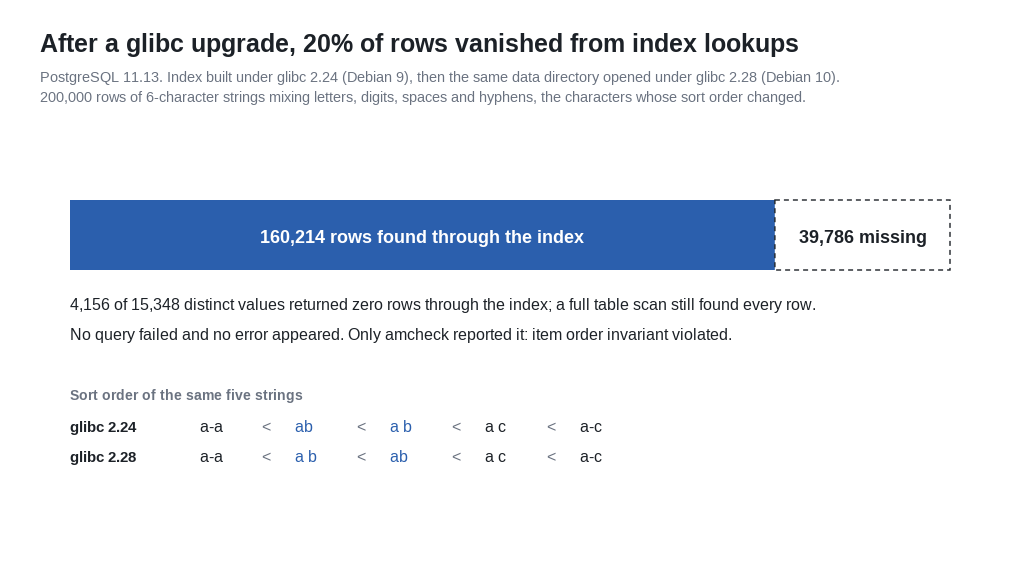
A lookup through the index found 0 rows for 4,156 of the 15,348 distinct values, 39,786 rows in total, while a full table scan still found every one of them. No query failed and no error appeared. Only PostgreSQL’s amcheck extension reported the problem: “item order invariant violated”. The test data deliberately mixes spaces and hyphens, which are the characters whose order changed. A real column of names or email addresses contains fewer of them, so the share of missing rows will differ. The mechanism is the same.
amcheck first, then REINDEX. Until then, queries can miss rows that exist and unique indexes can accept duplicates, all without an error.Scale turns each of these per-server problems into a fleet problem. A mid-size company commonly runs thousands of servers across its production, staging and development environments, and the largest operators run hundreds of thousands: in Part 1, Cloudflare could not reboot its hundreds of thousands of servers in time for the Copy Fail kernel flaw. At that size, some share of the fleet is always down for maintenance, and a patch that only misbehaves under one particular load can sit in the fleet for months before that load arrives.
That is what happened to Microsoft 365 on November 12. Microsoft’s post-incident review, as quoted by IncidentHub, traces it to a latent defect in a Windows update enabled on the networking gateway servers in front of Microsoft 365, a change that began rolling out in July. On November 12, nearly 14% of the gateway capacity was out of service for routine maintenance, a Teams failover moved extra traffic onto the gateway that also serves Exchange Online, and North American traffic reached its daily peak. Servers hit the defect under that load, and their traffic landed on the rest. At the worst point “more than 80% of the servers hosting the networking gateway service were unresponsive”, according to Microsoft’s Charles Lamanna, quoted on Wikipedia, and automated rollback could not help “as the change causing the error was deployed in July 2026”. Customer impact lasted 23 hours and 50 minutes. For the users it hit, that one day is almost three times the 8.8 hours of downtime a year that 99.9% availability allows.
Automatic updates, the cloud and live patching
Each of the three usual shortcuts takes over part of the job. None of them takes over the restart.
Automatic updates install patches without anyone deciding when. On March 8, 2023, that is what took Datadog down. A systemd security patch reached Ubuntu’s repositories on March 7, and the base image Datadog used for its Kubernetes nodes “had a legacy security update channel enabled”, so nodes across the fleet installed it in the same daily window, between 06:00 and 07:00 Coordinated Universal Time. The update restarted the network manager, which deleted the routes the container network depended on. Datadog’s deep dive says the change “disconnected more than 60 percent of our instances from the network”, across five regions, and the incident was fully resolved on March 10. Automation applied the fix exactly as designed, to thousands of nodes at once, the one rollout pattern that turns a bad patch into an outage.
Moving to the cloud moves part of the patching to the provider. Each provider documents which part. For AWS:
| Service | AWS patches | The customer still patches |
|---|---|---|
| Lambda, managed runtime | The operating system and language runtime, automatically by default | The function’s code “including its dependencies”. The other runtime modes hand the runtime back too. |
| Lambda, container image | Publishes updated base images | Rebuilding and redeploying the image. No deprecation notices are sent. |
| Fargate | The host and container runtime, by stopping tasks after 7 days’ notice (14 at most) | The container images |
| Elastic Kubernetes Service (EKS) | The Kubernetes control plane | The worker nodes’ operating system. Managed node groups replace nodes, but only when the customer starts the update. |
| RDS | The operating system and minor engine versions, in a 30-minute weekly window | Surviving the failover or the downtime, and major upgrades before support ends |
The pattern is consistent: the provider patches the layers it runs, and everything packaged by the customer stays with the customer. A container image is the clearest case. A patched base image fixes nothing until the image is rebuilt and redeployed, so an image built once and run for months can be the oldest software in the fleet. The container runtime under it has its own vulnerabilities too. In CVE-2019-5736 a malicious container could overwrite the host’s runc binary and get root on the host, and in CVE-2024-21626, part of Snyk’s “Leaky Vessels” disclosure in January 2024, a container could start with its working directory on the host’s filesystem. On Fargate AWS patches runc. On self-managed nodes the customer does.
Live patching applies kernel fixes to the running kernel without a reboot, through Red Hat’s kpatch, Oracle’s Ksplice or Canonical’s Livepatch. All three limit it. Red Hat ships live patches only for some critical and important CVEs, for up to a year per kernel, and its own announcement says “it’s unwise to go longer than a year without rebooting”. Canonical’s product page says that “Livepatch is not a replacement for rebooting”. Live patching buys time between reboots, and the reboot still comes.
When there is no patch left
Everything above assumes a fix exists. Software past its end of life gets no fixes at all, and then the patch turns into a migration: a new major version, a new distribution, or a new library, each a much larger change than a package update. Several common platforms crossed that line recently:
| Software | Free fixes ended | What is left |
|---|---|---|
| CentOS Linux 8 | December 31, 2021 | Paid support from third parties, OpenLogic’s through 2026 |
| CentOS Linux 7 | June 30, 2024 | Paid support, OpenLogic’s through 2029 |
| MySQL 5.7 on Amazon RDS | February 29, 2024 | RDS Extended Support, charged automatically from March 1, 2024, for up to three years, then a forced upgrade |
| Amazon Linux 2 | June 30, 2026 | Lambda runtimes built on it get critical fixes until their own deprecation dates |
| PostgreSQL 14 | November 12, 2026, with the last 14.x release | Upgrade to a newer major version |
| Linux long-term kernels 5.10 and 5.15 | December 2026 | Upgrade to a newer long-term kernel |
CentOS shows how long end of life can last. In Perforce’s 2025 State of Open Source survey of 433 people who work with open source, more than a quarter said their organizations still used CentOS, and more used CentOS 7 than Red Hat Enterprise Linux itself. Perforce owns OpenLogic, which sells the extended CentOS support listed above, and the respondents chose to take part, so the share is a signal rather than a census. It matches what I see in November 2026: I know companies still running CentOS on part of their fleet. It is not most of their servers, but those servers have had no free security fixes since June 2024.
End of life also catches the cloud. When AWS deprecates a Lambda runtime, the functions keep running and stop getting security patches, and AWS blocks creating and then updating such functions at least 30 and 60 days later. A function nobody has touched in years can sit on an unpatched runtime indefinitely. Part 1’s lib/pq example is the same problem one level up: a coding model swapped in an unmaintained PostgreSQL driver, and the next CVE in that driver becomes a rewrite.
A fleet of thousands, with fixes arriving daily and a three-day deadline on the worst of them, cannot handle any of this by hand. Patching now runs too often to be treated as a special event, and every run can break something, so it only works as a routine process that handles problems as they come up. That process rolls through servers in an order that keeps spare capacity, notices when a patch misbehaves and stops it before it reaches the whole fleet, and gives every restart an owner.
Building that process takes experienced engineers, subject-matter experts who know which servers can restart in which order, which database has to fail over first and which hand-made change will break at the next boot. That knowledge is hard to keep when staff hear that AI will replace them. On October 26, Microsoft offered voluntary buyouts to about 60,000 employees, roughly a quarter of its workforce, as it pours money into AI. The people most likely to accept such an offer are the ones with options elsewhere, and experienced engineers usually have them.
Part 3 covers the levels of automation and how teams organize that work.