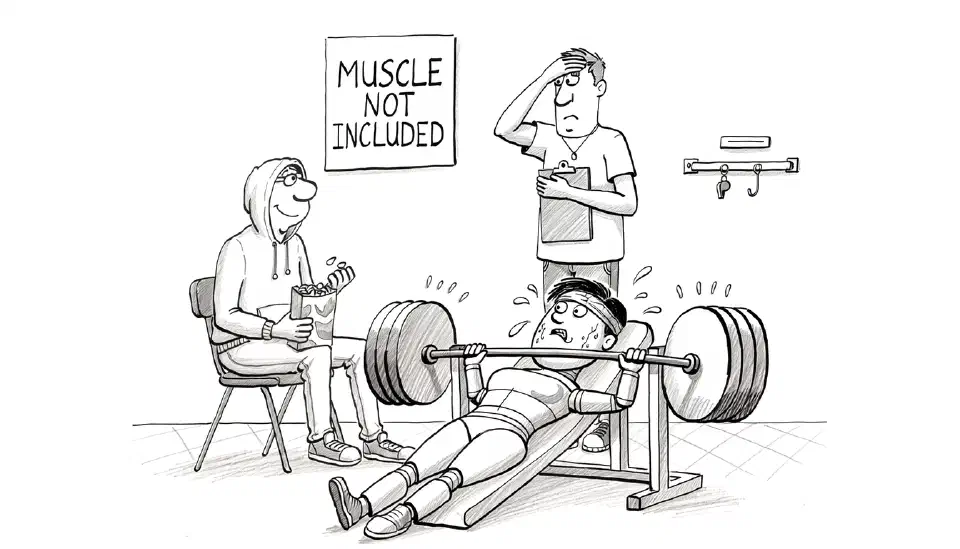
METR ran a controlled study in July 2025 on sixteen experienced open-source developers working in repositories averaging more than a million lines of code. Before the study the developers forecast that AI assistance would make them 24% faster, and afterward they believed it had made them 20% faster. Measured against the control, they were 19% slower. That is a gap of about forty points between what the work felt like and what the stopwatch recorded, on a population that does this for a living.
The gap matters because of what goes unnoticed inside it. Take a menu query that walks a self-referencing categories table with three LEFT JOINs. It is valid SQL, it returns the right rows when the test fixtures are three levels deep, and it silently drops every subcategory below the third level once the real tree is deeper. The shape that holds for arbitrary depth is a recursive CTE with UNION ALL, anchored on the root row and joining the table back to itself until no more rows come out. Five lines. A capable model will often offer the recursive version, or produce it the moment it is asked. The engineer who has never been burned by the fixed-depth one has no reason to ask, and no internal alarm that says three LEFT JOINs against a tree is the shape of a future incident. With both versions on the table, they cannot tell which one is load-bearing.
The obvious fix isn’t the fix
Review the agent’s code before approving it. True, and insufficient. The reviewer who has never written a tree walk over a self-referencing table doesn’t know what they should be looking for. They see SQL that compiles, returns rows on the test data, and matches the shape of the request. The internal alarm that says “this assumes a fixed depth, what happens when the tree is deeper than the joins” doesn’t come from reading SQL. It comes from writing the broken version yourself, watching it fail in production, and tracing the failure back through your own assumption.
Code review without that prior pain is pattern matching against the surface of the query. The bugs that ship through review are the ones where the surface looks right.
The other common answer is to put learning back on the calendar: a Friday afternoon for a course, some algorithm problems after hours. It tends to fail for a plain reason. The judgment eroded inside the delivery work, one accepted diff at a time and under deadline, and a calendar block is the first thing a sprint eats. General practice also rebuilds the wrong thing. The alarm that catches a bad migration is knowledge of one schema and its access patterns, of which table is too large to rewrite on the engine version actually running, and none of that is in a course.
The paradox
The paradox is that the speed and the judgment used to arrive together, in the same slow work, and now only the speed arrives. The engineer who accepts the output, reviews it briefly, and ships it has gotten the speed. They have not gotten the read on whether the query holds under the production tree shape, the security sense for whether the patch closed the CVE without invalidating something downstream, the scalability instinct for whether the join multiplies under real data, the maintainer’s eye for whether this diff doubles the maintenance work six months from now, or the operational feel for which parts of the system are load-bearing and which are decoration. None of those come bundled with the agent’s output. The five-minute version of the recursive CTE problem passes through them without depositing anything, the way watching someone debone a chicken on YouTube does not teach you when the knife is sharp enough.
Memory research measured this long before the tools existed. Roediger and Karpicke’s Test-Enhanced Learning (2006) had students either reread a passage or read it and then try to recall it. Five minutes later the rereaders scored higher. Two days and a week later, the group that had struggled to recall was ahead. Reading a smooth answer back from an agent is the rereading condition: it feels productive on the day and leaves little behind. Robert Bjork’s name for the useful kind of struggle is desirable difficulties, and his qualifier matters here, because a difficulty only helps a learner who has enough foundation to get through it. That is why watching the agent solve a problem in an unfamiliar part of the system teaches so little.
The same pattern shows up in wider data. Google’s 2025 DORA report found 90% of developers using AI and over 80% reporting it made them more productive, and its headline conclusion is that AI’s primary role is “as an amplifier, magnifying an organization’s existing strengths and weaknesses”. More output per engineer means more for someone to verify, and that work moves to the reviewer. The skill that makes a reviewer fast (recognizing which agent-generated PR is hiding a fixed-depth assumption, or a missing index, or a quietly invalidated invariant) is the skill the same reviewer is no longer building by writing the slow version themselves.
Cloudflare’s write-up (May 2026) of pointing a security-focused model at more than fifty of its repositories, through Anthropic’s Project Glasswing, lands on the same shape from the security side. When they let the model write its own patches, some of them “fixed the original bug while quietly breaking something else the code depended on”, and a few of those went out. Catching that kind of patch takes someone who can read a regression suite and notice that a load-bearing assumption has been invalidated, and that recognition is built over years of debugging exactly that class of mistake. Accepting the patch without it means shipping the regression and learning nothing in the process.
The slow-onset failure
The damage falls hardest on engineers who came up after the tools landed. The current cohort of senior engineers built their judgment in a decade when the slow work was the only available path. Every recursive query was a recursive query they had to figure out. Every migration was one they had to plan. Every 2 a.m. incident was one they had to root-cause without a model offering a first-guess hypothesis. The path that produced today’s seniors ran straight through the slow work the agent now does on demand.
Juniors who let the agent do that work will not arrive at the same place by the same route. Three years of accepting every agent PR, and the engineer who used to be a junior in their codebase is still a junior in their codebase, except now the codebase has grown more complex and the parts they don’t understand have grown faster than the parts they do. The gap doesn’t show on day one, or month six, or even year two. It shows the first time the agent produces output the engineer cannot evaluate: when the question a senior would ask about a migration is one the junior doesn’t know to ask, or when the bug in the agent’s PR is invisible to anyone who hasn’t written the broken version themselves (What AI Gets Wrong About Your Database measures a database version of this: a model that could not know what an undocumented status code meant, said so in a comment, and still returned a number that only a reader who already knew the answer could check).
The calibration
The skill worth building is knowing which work the agent should do, which work you should do by hand, and which work you should accept from the agent and then rewrite anyway to internalize the pattern.
The agent is the right tool for work where the context you’d gain by doing it yourself is marginal. Boilerplate. Syntax you’d otherwise look up. Test scaffolding for code paths you already understand. The migration template you’ve written for the tenth time this year. The fifty-line helper that’s mechanically obvious once you’ve decided what it should do. Let the agent handle these with a brief review and move on.
The agent is the wrong tool for work where the context is the asset. The parts of the system you don’t yet understand. New code paths through a critical module. Database changes whose consequences you’d want to feel in your fingers before approving them in production. The first recursive CTE against a tree-shaped table you’ve never queried before. The first incident in a class of failures you haven’t seen, where the agent’s hypothesis is a hypothesis you should also be forming yourself. Do this work by hand, even when the agent would have produced a working diff faster. The slow version is what builds the alarm that catches the agent’s mistake the next time the same shape of work shows up.
The hard part is the middle. Work that’s neither pure boilerplate nor entirely novel. Some of it belongs in a tight loop where you drive and the agent assists on syntax. Some gets reviewed line by line as a learning exercise rather than a compliance step. The rest gets rewritten by hand after the agent produces a working version, just to deposit the pattern in your own muscle. The choice turns on whether the work sits in a part of the codebase you need to know deeply or one you can afford to treat as a black box.
For the work kept by hand, a few habits cost different amounts, and they do not have to be adopted together.
| Habit | What it costs | Where it fits |
|---|---|---|
Guess first: predict the query plan before running EXPLAIN, or the cause before reading the stack trace, then compare with the agent’s answer | Seconds to a few minutes per task | Everyday work in the domain being built. It turns reading an answer into the recall-then-feedback loop from the study above |
| Solve it by hand even when the agent is faster | The agent’s speed on that task | The domain the career bet is on: query tuning, lock analysis and plan regressions for a database engineer |
| Merge nothing that could not be explained line by line | Slower merges, and some agent output sent back or rewritten | Migrations, auth paths, anything that takes a lock or changes an invariant |
| Turn the agent off every few weeks and solve a core-domain problem cold | An hour or two | As a gauge. A problem that was fluent two years ago and now feels foreign is the reading |
| Delegate fully and review briefly | Losing the ability to tell a competent answer from a confident one in that area | Boilerplate, throwaway tools, domains outside the role |
Reasoned from the argument above. None of these habits was measured.
A live incident is its own case. With customers down, every tool that shortens the outage is worth using, the agent included, and the hand work moves to the postmortem, where the failure gets reconstructed without it.
The argument cuts cleanest for engineers building depth in a domain they intend to stay in: a platform engineer who needs to know the database, a backend engineer whose career bet is a specific stack, a frontend engineer whose framework just shipped thirteen advisories in one coordinated security release (middleware auth bypasses, SSRF, denial of service in React Server Components, across Next.js 13.x through 16.x) and who needs to read their own dependency graph well enough to know whether they were exposed. It cuts less cleanly where depth is not the point. The throwaway script that ships in an afternoon and dies in a week is one case (The 10x Is Real, on Internal Tools You’d Otherwise Never Ship covers that end of the spectrum). The pre-product-market-fit startup is another, since its codebase is throwaway in expected value and the bill only arrives if the product wins.
Senior engineers who already have the context sit outside the problem. The one who has written the recursive CTE a dozen times can accept the agent’s first draft and review it competently, because the alarm is already wired. The cost falls hardest on the engineers least equipped to see it.