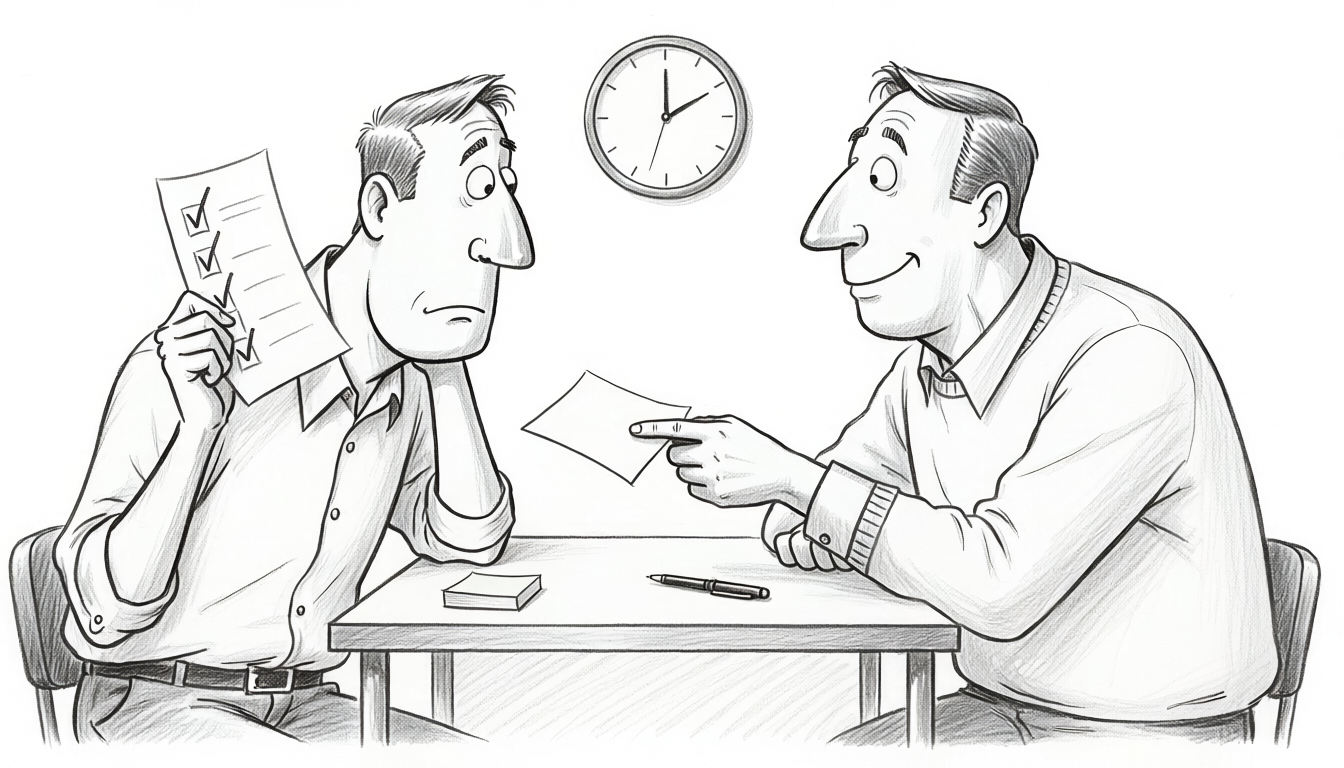
It is 3pm on a Tuesday. The team meets for fifteen minutes. The first engineer reads back this morning’s declaration: green CI on the orders-export flake by 1pm. What actually happened: CI is green, but the snapshot endpoint is slow enough that the test takes eight minutes, which probably isn’t tolerable. Two minutes of conversation. Someone else hit a similar slow-endpoint problem last quarter and links the PR. A third engineer suggests a smaller fix that gets the test under three minutes. The first engineer goes back to their desk with a concrete next step and three hours to finish.
A 9am standup could not have produced that conversation. At 9am the engineer didn’t know the snapshot endpoint was slow; they were committing to green CI. By the time they hit the slow-endpoint problem at 12:30, the morning meeting was four hours behind them, and the teammate with the fix had context-switched to something else. By 5pm, the conversation that could have unblocked the engineer is happening with no work day left to act on it. 3pm is the sweet spot, and the morning declaration is what the 3pm session is anchored to.
The reflex is to fix the morning meeting instead. Run it tighter. Ask better questions. Replace it with Geekbot or an async post in Slack. Each produces a marginal improvement without changing what the format can do, because the morning is the wrong moment for solving problems. At 9am, today’s blockers haven’t surfaced yet. The conversations that could resolve them are happening eight hours before the conversations are useful.
Two artifacts, one cadence
The morning declaration goes into the team channel before the IC starts work, typically by 10:00 local time. The post answers three questions: what I’m working on today, what outcome I’m aiming for, what could block me. Two to four sentences. A single focused goal, not a list of three. A statement of intent that the IC, the lead, and the rest of the team can all read.
A real example:
Working on the orders-export flake (#4127). Aim: green CI by 1pm. Blocker if it turns out to be the upstream snapshot endpoint, in which case I’ll switch to the dashboard cleanup ticket.
Compare to “today I’ll keep working on bug #4127, no blockers.” The first names a target and a failure path. The second is filler. The act of writing the first one forces the IC to commit to something concrete and to audit whether it fits in a day. The second is something an IC can recite half-asleep.
The mid-day sync meets around 3pm, fifteen to thirty minutes. Each IC’s contribution starts with status: what I declared this morning, what actually happened so far, where I am right now. That part is unavoidable and useful. The rest of the team needs the read. The differentiator is the second beat: what isn’t going to plan, what could help. Each contribution is anchored to the morning post, which means the team works through real, named issues in real time once the status piece is on the table.
3pm is the load-bearing detail. A meeting at 5pm reports problems that already cost the team a day. A meeting at 11am hasn’t seen most of today’s blockers yet. 3pm is when today’s reality is mostly visible and today’s work day still has runway. A blocker named at 3pm is one a teammate can suggest a fix for at 3:05 and the IC can act on at 3:10. The same blocker named at 5pm is tomorrow’s problem.
The two artifacts are paired. The morning declaration is what the 3pm sync is anchored to. Without the morning, the 3pm meeting is a synchronous standup with all of standup’s problems. Without the 3pm sync, the morning is a pile of writing the team never discusses, and the productivity benefit evaporates the same way classic standup’s information does.
Why this raises output
Several mechanisms compound.
One focused goal per IC, declared in writing, beats a list of three. Teams that try to ship four things a day per IC finish fewer than teams that pick one, and Sophie Leroy’s 2009 paper on “attention residue” (Organizational Behavior and Human Decision Processes, vol. 109) names the mechanism: cognitive load from an unfinished task A persists into task B, even when nothing in the environment is reminding the worker of A. Declaring one thing in the morning forces the IC to name the priority before the noise starts. The declaration is also a forcing function for honest scoping: an engineer writing “today I’ll finish the export refactor and start the migration” notices, in the act of writing, that two days of work won’t fit in one. Speaking has no such friction. A standup at 9am hears “I’ll work on the export and start the migration” and nobody, including the engineer, has audited the claim.
Writing is binding, and the binding holds because the writing sticks. The commitment-and-consistency principle in social psychology (Cialdini’s Influence, 1984, building on Deutsch and Gerard’s 1955 work on normative social influence) is the canonical statement: written commitments produce more consistent follow-through than spoken or merely-considered ones. A goal stated in writing, in a public channel, with a name attached, is a stronger commitment than the same goal mumbled aloud at 9:02. By 10:00, most of what was said at 9:00 is gone, not only from the listeners but from the speaker, who at 4pm cannot reliably recall what they committed to. The morning post is still readable at 4pm. Anyone who joined late, anyone in a different time zone, anyone in a partner team that needs to know what your team is touching today, can read the channel.
The live 3pm sync produces saves the rest of the format cannot. Someone’s blocker is someone else’s two-minute fix; the live, bounded conversation surfaces the fix while the IC still has runway to apply it. Async help in Slack threads doesn’t carry the same load: nobody is required to read at any particular time, and a fix offered at 4:45pm with the IC heads-down is functionally a fix offered tomorrow. The sync works because everyone is present, the conversation is short, and the help is actionable now.
The sync also builds a different kind of team feeling than ad-hoc help does. Going through real issues together in a session everyone planned to attend produces hints, half-remembered prior fixes, and “oh, I had this last week” moments that don’t carry the social cost of random interruption. A teammate pinged at 2:34pm pays a context-switch cost the asker doesn’t see; Gloria Mark’s research at UC Irvine on interrupted work has consistently measured refocus times around twenty to twenty-five minutes after a single interruption. That cost disappears when the conversation is the format. Over a quarter, ICs hear each other think out loud and the team starts to know each other as collaborators rather than as Slack avatars.
Achievement compounds morale. Declaring something and getting it done is its own reinforcement. Teresa Amabile and Steven Kramer’s analysis of nearly 12,000 daily diary entries from 238 knowledge workers (The Progress Principle, Harvard Business Review Press, 2011) found that perceiving daily progress on meaningful work was the single biggest driver of inner work life and motivation, larger than recognition or compensation. A team where ICs make daily declarations and meet most of them ends each week with a visible record of completed commitments. That isn’t a soft benefit. Over a quarter, it’s the difference between a team that perceives itself as producing and one that doesn’t, and the perception drives the next quarter’s output. Teams that don’t see their own progress slow down regardless of the underlying work; teams that do speed up.
Inclusivity falls out of the format. Written-first formats produce more balanced contribution than live round-robins. Quiet team members get equal weight when their declaration is in the channel, and the 3pm session anchors back to what they wrote rather than rewarding whoever talks first. Over a year, this is the difference between knowing what your introverts are doing and not.
Where this fits among existing patterns
Most components are not new.
Async written standups are widely practiced. Geekbot, Standuply, Range, and Polly are tools built specifically for the morning-write half. Basecamp’s Check-ins does the same thing. GitLab’s handbook documents an async-first variant publicly, as do Doist (Twist), Automattic, and parts of Basecamp’s own engineering. Anyone who has worked at a remote-first org in the last five years has probably written one of these.
What is less common is the deliberate pairing with a same-day live sync, and the timing of that sync at 3pm rather than at end-of-day. Most teams that move to async written standups skip the live half entirely. Most teams that keep a live standup don’t bother with the written morning. End-of-day retros exist in some agile shops but tend to surface problems too late to act on them today. The 3pm window is the productivity unlock, and it isn’t formalized in any of the named tools.
The other less-common piece is using the written trail as a coaching primitive. Some tools surface trends, but most teams treat written standups as status updates rather than as longitudinal evidence about how an IC scopes their work. The same artifact that makes the morning bind makes it readable as a coaching signal across days and weeks.
The article isn’t claiming async standups are new. The combination (one-goal morning declaration + 3pm team sync + multi-day longitudinal use) is the angle worth picking apart.
How team leads use the trail
A week of declarations, read together, is a different artifact from any single one. A lead reading Monday-through-Friday for one IC sees the rhythm of declarations, what’s being achieved, what’s drifting, where the IC chooses to spend focus.
Three patterns:
- Weekly review. Skim the week’s declarations on Friday or Monday. Look for ICs whose intent and outcome diverged repeatedly. Look for blockers that recur. Look for scope that grew without being renegotiated.
- 1:1 prep. Walk into the 1:1 with the IC’s last two weeks of declarations open. The conversation has a concrete anchor instead of “how’s everything going.”
- Drift detection. When an IC’s declarations stop matching outcomes, when blockers recur, when commitments shrink without explanation, the trail surfaces it before the next sprint review does.
The discipline cuts both ways. A lead who reads declarations as ammunition turns the artifact into a control mechanism, and the team adapts by writing declarations that are safely vague.
Failure modes
The structure has its own anti-patterns.
- Declarations become theater. “My goal: fix bugs” produces nothing useful at 3pm because there’s nothing concrete to talk through. The fix is to push the format toward concrete outcomes (a ticket number, a measurable end-state) and to model good declarations from the lead’s own posts.
- The 3pm sync collapses to status alone. Some status is built into the format and that’s fine. The failure mode is when status is the whole meeting. When the lead asks “what’s your update” and nobody jumps in with a fix, a question, or “I had this last week,” the meeting has reverted to a synchronous standup with extra writing overhead. The discipline is the second beat: surfacing what isn’t working and inviting help on it before the next person reports.
- Over-commitment in writing. Engineers declare more than fits in a day because written commitments feel public. Two weeks of “declared three things, finished one” is a coaching signal, not a discipline issue. The format is asking for honest scoping; the lead’s job is to model it.
- Declarations nobody reads. If the morning post goes into a channel nobody scrolls, the persistence benefit evaporates and the 3pm session has no anchor. The fix isn’t more pings. It’s making the channel a routine read for the lead, the partner teams, and the IC’s peers.
- The 3pm slot gets eroded by other meetings. Mid-afternoon is prime calendar real estate, and over a quarter the slot can be eaten by partner-team syncs, reviews, and one-offs. Defend it. Moving the sync to 4:30 to accommodate another meeting kills the productivity property the 3pm timing was buying.
When classic standup is still the right tool
This isn’t a one-size-fits-all replacement.
Tight single-time-zone teams get less from the async morning. A team in one office, all in the same five-hour window, can run a synchronous standup at 9:00 and the persistence benefit is small because everyone is already in the same room. The 3pm sync still pays back; the morning declaration is the part that becomes optional.
Very small teams (three or four people) face overhead high relative to size. A daily fifteen-minute conversation accomplishes most of what the two-stage format does, and the multi-day coaching trail matters less when the lead can ask any of three people directly.
Pair-programming and mob-programming workflows complicate the morning declaration. The artifact becomes the pair’s intent, not the individual’s. The 3pm sync still works; the longitudinal trail is less useful because the artifact you’re reading is the pair, not the IC.
Crisis modes are the clearest exception. Incident response, deploy days, anything where the team is already on the same shared context for hours. Use a war-room channel and resume the regular cadence after.
Trade-offs
This isn’t free.
ICs do more writing every day. Five sentences before 10am may not sound like much, but compounded across a year and a team of ten it’s real overhead. The format is paying for that with output, morale, and a coaching trail. If none of those matter in the team’s context, the cost isn’t worth it.
The 3pm slot is expensive calendar real estate. Carving fifteen to thirty minutes out of the most productive part of the work day is a real tax, paid back in problems solved while still solvable. A team that can’t defend the slot will see the productivity benefit decay over a quarter as the meeting slides later or gets cancelled.
The format depends on psychological safety. A team where missed commitments become punishment material, where blockers are punished as weakness, will produce performative declarations regardless of the format. The structure amplifies whatever the team’s actual culture is.
The longitudinal trail can be misused. Already named in the failure modes; the most expensive failure because it kills the productivity benefit fastest. The same artifact that makes the format work as coaching makes it dangerous as compliance theater.
The tooling fit is partial. Geekbot, Standuply, Range, Polly, and Basecamp Check-ins each support parts of the structure. None map perfectly to “morning declaration + 3pm live sync + longitudinal trail.” Most teams running this end up with a Slack channel for the morning, a recurring 3pm calendar event, and the lead’s own notes for the trail. The tooling is a wrapper around the discipline, not a substitute for it.
The bigger picture
The test for whether this format fits a team is concrete. Does the lead read the morning declarations, and does the 3pm meeting actually run as a working sync? If both are true, the productivity gain is real. If either drifts (the channel goes unread, or the meeting becomes a status round) the format collapses to a more expensive version of the standup it was supposed to replace.
Teams that try this and abandon it usually abandoned it because they kept the format and dropped the discipline. The format is cheap. The discipline is the part that ships.