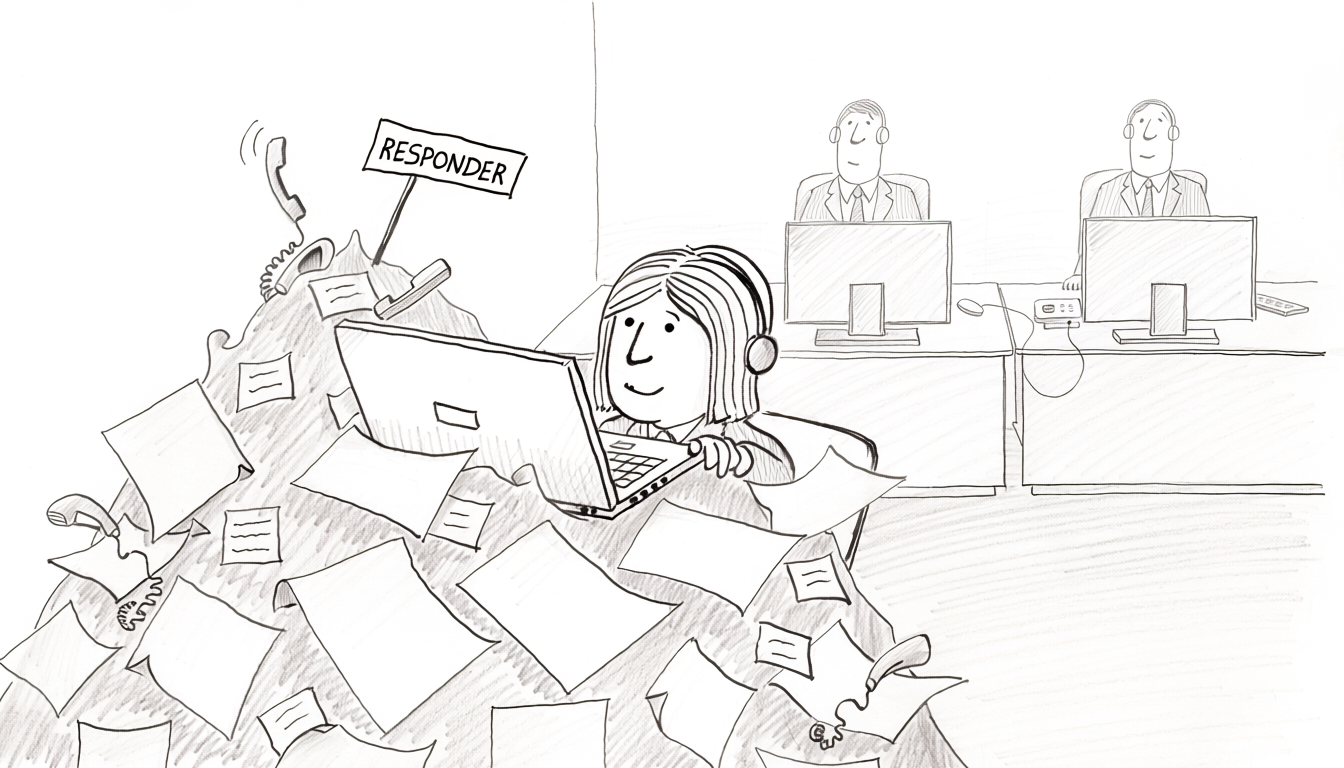
A team has a responder rotation. The responder’s name is in the channel topic every Monday. Six months in, the database alert that pages at 2am still goes to Sarah because she wrote the schema in 2024 and nobody else has dug into it. The Kafka partition imbalance at 3pm still goes to Marcus. The Redis eviction issue still goes to whoever has been on the team longest. The responder forwarded all three to the original owners within two minutes of the page. The rotation existed. The silos held. The responder name on the calendar was a routing layer, not a learning one.
That is the failure mode the rest of this post is about. The rotation is necessary but not sufficient. What separates a working rotation from a name on a calendar is a small set of operational rules that force the responder to actually own the work, not just route it.
The reflex is to write down a clearer rule: the responder handles everything, no exceptions, never escalate. That fails on first contact with a real production page. The 2am Kafka issue is genuinely faster to resolve if Marcus picks up. The customer is on the line. The deadline is tomorrow. Saying “no, the responder must learn” costs the company money this week and won’t carry next week either, because the next 2am page also has a real-world reason it should go to the specialist. “No escape” is not the rule. The rule that holds is a different shape.
The five rules
Each rule sits below the prompt the team gives itself, in a layer the team has to defend actively. None is novel on its own. The combination is what makes the rotation produce the silo-breaking it claims.
-
Resort order: runbooks, then docs, then internal LLM, then SME. Before the responder asks a human, they work through the documented self-serve options in order. Runbooks for known incidents, docs for system understanding, an internal LLM or RAG tool for synthesis across both, and only after those run out, the SME. The point is not to ban the SME. It is to make sure the responder has tried the cheaper rungs first, so that when the SME does get pulled in, the conversation starts from “I read the runbook section on this and tried X, here is what I’m seeing” instead of “what is this and what do I do.”
-
SMEs advise, they don’t take handoff. When the responder consults the SME, the conversation produces a path forward, not a transfer. The SME explains the issue, suggests the next steps, and goes back to their declared work. The responder owns the ticket through resolution and writes the resolution into the runbook. This is the rule that turns “ask Marcus” into knowledge transfer instead of work transfer.
-
Alert and ask routing tiered by urgency and source. The responder watches a high-signal channel actively for prod alerts and urgent asks, skims a separate channel for non-prod, and works a Jira queue between fires for non-urgent automated signals (failed nightly backup, config drift, flag mismatch). Asks from other engineers, especially storage-team work like Kafka or Redis, go to a live conversation channel rather than a ticket queue; tickets get filed downstream when the conversation produces work worth tracking, they are not the entry point. The detailed channel structure, severity policy, and alert-tuning discipline get their own treatment in Part III.
-
Improvement tickets generate themselves. Every recurring incident produces a ticket. A noisy alert that fired three times this quarter gets a tuning ticket. A runbook gap the responder hit gets a doc-update ticket. An LLM that gave a confident wrong answer gets a source-update ticket. The rule works because the role concentrates pain on one person for five days: the responder absorbs what is normally scattered across the team, and the person paged at 2am is the same person who will write the runbook on Wednesday. If the same fire happens twice in a quarter and no improvement ticket exists, the rotation is wallpapering toil instead of reducing it. The improvement queue is also the team’s most honest signal that the rotation is working: if the queue is shrinking and the runbooks are growing, the responder is producing the cross-training the rotation promised.
-
Reduce responder load only through tech, never through policy carve-outs. As the rotation matures and the team wants to make the responder’s week easier, the only valid mechanism is technical implementation: new automation, better runbooks, alert tuning, self-service tools for partner teams who keep asking the same questions. Carving out categories back to the SME, lowering the bar for what the responder is expected to handle, or routing painful asks somewhere off-stage all shift toil rather than removing it. Tech implementation takes the toil out of the system entirely. Every responder week that produces a real engineering ticket reduces what the next rotation has to do. Policy carve-outs do the opposite, quietly.
What the five rules buy for the rest of the team is a clean focus week. The non-responder ICs are not in the partner-team channel triaging asks, not fielding DMs about Kafka topics or Redis schema, not on the other end of the 2am page. They are doing the work they declared on Monday, with the morning declaration and 3pm sync from Part I structuring their day, and they are finishing what they started. A morning declaration is a goal that four hours of unscheduled interruption will eventually destroy. The rotation is what protects the declaration long enough for the IC to actually finish it.
The cost of all five is real. Each requires discipline that is easier to skip than to keep. The SME who always picks up will keep picking up unless the team explicitly stops the handoff pattern. The improvement-ticket discipline only works if there is a half-hour each rotation set aside to file them, and rotations under heavy load lose that half-hour first. The tiered routing requires actively maintaining alert filters and channel topology that drift fast. The tech-implementation rule asks the team to file real engineering work after each rotation, which competes with sprint commitments and slips when sprints get tight. None of this is one-time setup. The rules are an active practice the team defends the same way it defends the 3pm sync slot from Part I.
Handoff at the week boundary
The responder’s week ends Friday afternoon. Three categories of things sit in the queue.
Open incidents and paused investigations get explicitly handed off in a written note: what is the state, what is the next action, what was already tried, who has been pulled in. The note is short. Half a page is plenty. Bullet form is fine. The rule is not that everything is exhaustively documented; it is that nothing is silently dropped.
Closed work gets closed, with whatever runbook update or follow-up ticket the resolution produced. Improvement work the responder identified but didn’t get to becomes a backlog ticket, scheduled into someone’s planned-work queue rather than left to the next responder to either pick up or ignore.
The next responder picks up Monday morning with full context on what is actually inbound. No ramp-up day spent figuring out what the previous week was working on. No ticket that quietly got dropped at the rotation boundary because nobody owned it across the weekend.
What the responder does not handle
A working rotation is honest about specialization. Some categories of work genuinely require the specialist, and naming them upfront prevents the format from feeling like a fiction.
Security incidents. Corner-case data-recovery operations. Load-bearing decisions that require historical context the rotation can’t reasonably build (the schema choice from 2022 that has shaped every query since). The responder still owns the ticket and stays in the loop, but the actual work happens with the specialist driving and the responder learning. Over a quarter, the responder may move into the specialist column for some of these. Some they won’t, and that’s fine.
When this doesn’t apply
The structure earns less than its cost when interrupt volume is too low. If the team gets pinged twice a day and most of those are easily handled, the rotation is a structure without a job. Volume is the test, not team size or specialization. A three-person team with heavy operational load still benefits from concentrating interruptions on one person while the other two ship sprint work; a ten-person team with light load doesn’t. A team of four MySQL DBAs benefits more from rotation, not less, because everyone can handle everything; uniform specialization makes the rotation easier, not harder. The format earns its cost when interrupt volume is high enough that focused weeks are otherwise impossible.
The bigger picture
A working responder rotation has visible evidence: improvement tickets are filed every rotation, the rotation’s interrupt volume is trending down quarter over quarter, the runbook count and quality is going up, and at handoff Friday the next responder receives a written note rather than a tribal-knowledge briefing. None of that is rocket science. All of it requires the team to defend the rules every week against the easier path of letting the SME pick up.
The teams that abandon the rotation usually didn’t abandon it because the rotation was wrong. They kept the calendar entry and dropped the rules. The SMEs kept picking up, the improvement tickets stopped getting filed, and the rotation became a name in a channel topic that nobody was treating as load-bearing.